

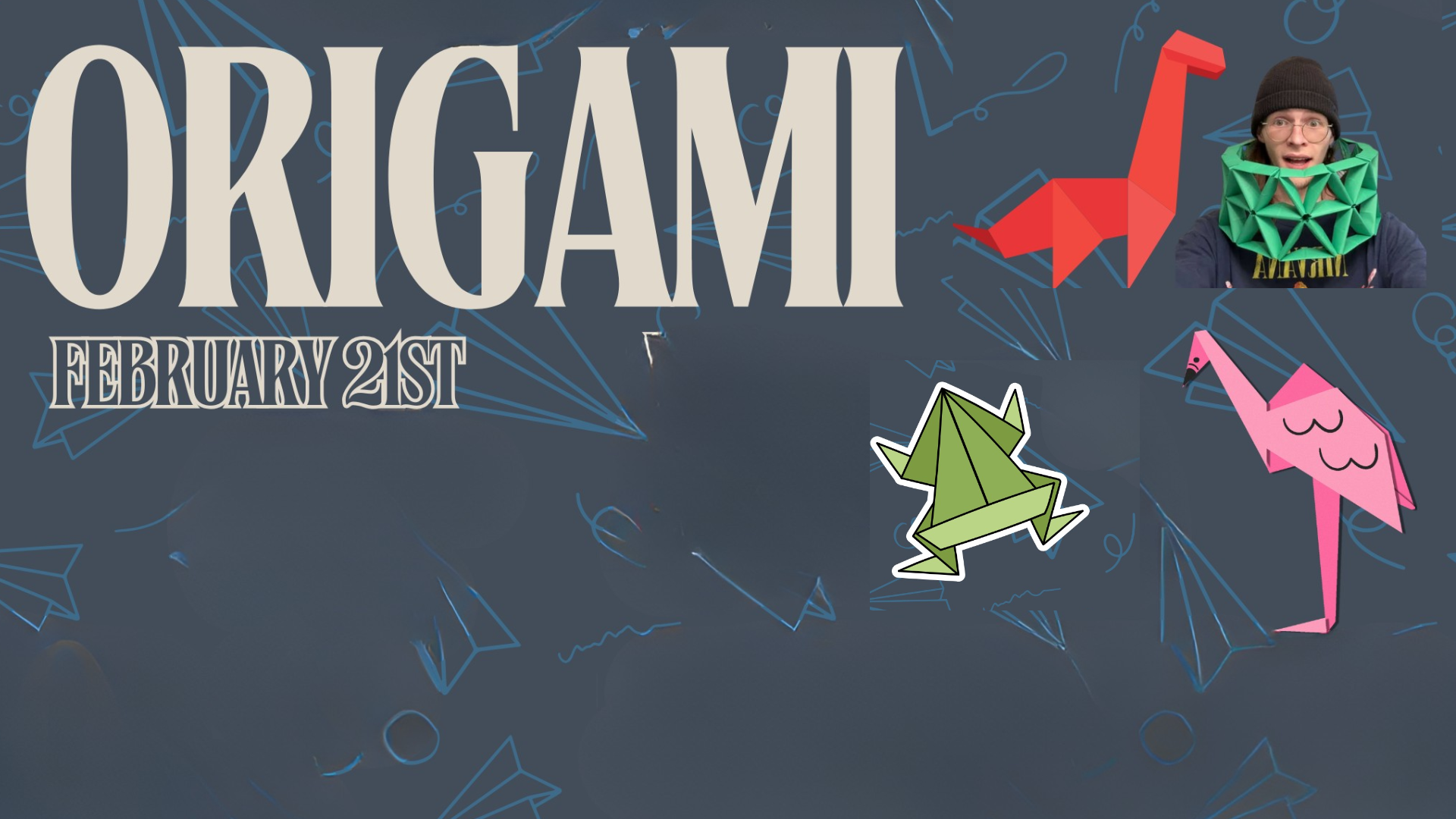
Beginner Modular Origami Class with Ace Phelps
Saturday, February 21 @ 2:00 pm - 4:00 pm
| $50Beginners Modular Origami Workshop, Part I
Instructor: Ace Phelps
Learn how to fold and assemble Modular Origami 3-D Sculptures in Part 1. Instructor Ace Phelps will help students to foster creativity and students learn the basics of Modular Origami before moving on to creating more complex project of their own designs in Part 2.
Modular origami is not only a creative art form but also a mathematical exploration, as many models are based on geometric principles. It can be used to create decorative objects, educational tools, and even complex sculptures that demonstrate mathematical concepts.
Saturday, February 28, 2026, 2:00 – 4:00 pm
Ages 13+
Cost: $50.00
About Modular Origami:
Modular origami is a fascinating and intricate form of paper art that combines creativity with mathematical principles, allowing artists to create stunning three-dimensional structures from simple folded units.
Modular origami is a paper folding technique to create multiple identical units or modules, which are then assembled into complex three-dimensional structures without the use of glue or tape.
Also known as unit origami, this form of origami uses individual sheets of paper, folded into units that are interlocked or assembled together. This technique allows for the construction of intricate models, such as polyhedra, flowers, and geometric patterns, by combining simple, repetitive units. The primary goal is to create larger and more elaborate structures than traditional single-sheet origami, emphasizing geometric harmony and precision.
The origins of modular origami trace back to the ancient Japanese art of kusudama, which involved folding paper to create vessels for holding incense and potpourri. Unlike kusudama, which typically uses string to connect units, modular origami relies solely on folds to join components together. The first historical evidence of modular origami appears in a Japanese book published in 1734, which depicted a modular cube.
Characteristics of Modular Origami include: Multiple Units: Modular origami involves creating numerous identical or similar units that fit together snugly.
Interlocking Assembly: The units are designed to interlock through precise folds, eliminating the need for adhesives.
Geometric Symmetry: Many modular origami models showcase various forms of symmetry, enhancing their visual appeal.
Repetitive Process: The folding of basic units is repeated, promoting precision and consistency in the final structure.